
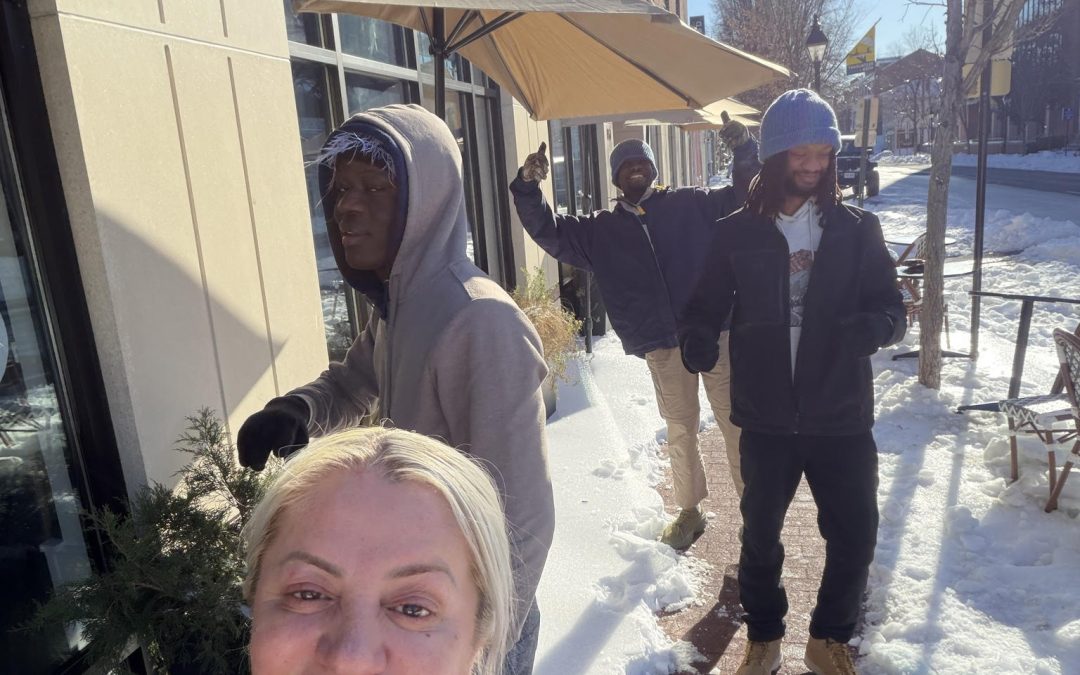
Fredericksburg had frozen over.
Where accumulation underperformed, the thickness of Jack Frost’s blast had accommodated.
In typical snow day tradition, members of the Micah community were clamoring for shovels at the first sign of flakes. Where snow signals hot cocoa and jammies, days off from school and an excuse to stay off the roads for many of us; snow, when you live with your back against the ground means “money.”
Our unhoused neighbors might struggle to find steady work, but boy can they seize a snowstorm for a solid day’s earnings.
I’ve been so impressed with what our neighbors accomplish on previous snow days, that this year I decided to try something different. Within moments of posting in a downtown business owners’ Facebook page, my phone started pinging.
“How much?”
“How soon can they get there?”
“My address is…..Please help.”
Business after business, some snowed in outside of town and others not physically able to chip the ice off their walk, sought relief.
This time, our unhoused neighbors were not the problem. They were the solution.
I’m grateful that our neighbors—sleeping on the floor of the Baptist Church at the time—were able to make money. I am grateful, at a time when the snowplows were struggling, the Micah community could show up for our city as good neighbors.
But my favorite part of the story is how, for a moment, the roles between unhoused neighbors and business owners shifted—and both began to see each other differently.
In Acts 9, there was a man who was absolutely convinced he knew everything there was to know about early followers of Jesus.
As a devout Jew, Saul’s life centered on law as the way to have a relationship with God. Everything about Christ followers, who called themselves “The Way,” conflicted. They were making dangerous claims—that Jesus was Lord, that grace was available to all, and belonging was no longer defined by the authority of the religious system.
The people of “The Way” lived differently. They gathered outside the temple. They welcomed people the priests would have kept at a distance. And they trusted grace where any good Pharisee would have demanded certainty.
In Saul’s mind this was not just a disagreement.
It was a threat. A threat to the faith he loved. A threat to the order that held his world together.
So, he did what made sense to him.
With the backing of religious authority, he set out to stop it—tracking down those who followed Jesus, dragging them from their homes and bringing them back in chains.
Saul was certain he could see clearly; and that certainty…is exactly what made him dangerous.
The best part of the story, however, is how the roles between Saul and those he wanted out of the way shifted—and both began to see each other differently.
The good news of this story is not that Saul finally figured it out—it’s that Christ came to him while he was still wrong.
On a road, through an encounter, and into a calling, God interrupted Saul’s life… and profoundly reshaped it.
The Road
As Saul walks along the dusty Damascus Road, his sin is not what he is doing wrong—it’s that he is unable to see the ways that God is at work without him. His mission is not interrupted in a synagogue, a worship service or theological debate. He is in the middle of nowhere—far from the high priests, the structures that gave him confidence, far from the comforts of being right.
And especially there, Saul doesn’t choose Jesus.
Jesus confronts Saul.
Saul thinks he is advancing the flourishing of the world by getting rid of people, but they are the ones with whom Christ identifies most closely. There is a blinding light, a voice, and Jesus says, “Saul, Saul, why do you persecute ME?” Not my people, not my followers—Me. Jesus equates Saul’s actions to a direct assault against himself.
In that moment, all the things Saul thought he saw clearly—his certainty—collapsed.
And yet, God does not destroy Saul. God claims him.
Because grace does not wait for us in certainty—it meets us in the middle of things, and interrupts.
The Encounter
Blinded, Saul—the powerful crusader—becomes completely dependent. He is led by the hand. He cannot see. He cannot eat. He becomes vulnerable to the very people he once pursued.
But notice—
Saul’s blindness is not where he finally figures things out. It is where God begins to remake him.
In darkness, Saul is stripped of control and brought to a place of vulnerability. He must unlearn what it is to be certain to assume a position to receive.
Because grace doesn’t begin when we understand—it begins when we are finally brought to the end of ourselves.
The Calling
Saul would have had no use for Ananias—until he needed him. Without God’s urging, Ananias would have avoided the man from Tarsus who was persecuting disciples such as himself. But when the one who was feared became the one who was afraid, and the one who was afraid crossed the lines of fear, God reshaped relationship in the form of the cross—and enemy became “brother.”
Two callings are fulfilled that day.
Ananias does not go because Saul has proven himself safe. He goes because God has spoken. In his obedience, Ananias becomes the means through which Saul can become the instrument God is calling him to be.
But there is a moment of hesitation.
“Lord…I have heard about this man.”
Of course he has.
How could God be calling him to go to a man who has caused so much harm? Surely, Saul does not deserve it. Ananias is certainly not ready. But God is already at work.
Because grace doesn’t wait for us to be ready—it meets us when we are still afraid.
Saul’s life changes on the road, but it becomes whole when Ananias walks through a door he would rather avoid. Ananias’ life changes when God instructs him to “Go,” but it becomes whole when he enters “enemy” territory and becomes part of another’s healing.
And maybe that’s where this story meets us. Not in being Saul, but in being people willing to go, even when we are unsure, even when we are afraid, trusting that God’s grace goes before us.
Snowstorms are not the first, nor will they be the last disruption our community experiences, as God works through unhoused neighbors to enrich our lives and peels the scales from all the certainties we think we have about the world.
With God’s help, unhoused neighbors have been our teachers, the community that once dismissed them showed up nearly a thousand strong for the Coldest Night of the Year walk, and you may have heard…this mustard seed of an idea has now morphed into plans for a supportive housing neighborhood—a permanent home for our neighbors in Jeremiah Community.
Jeremiah Community will be a place where our neighbors can live affordably and grow meaningful relationships. But you know what I can’t wait for? The ways this home for our neighbors will encourage purpose. Answering the phone, being part of the grounds crew, running the laundry room, working in the kitchen, driving the golf cart, and so much more, are ways the people who live in Jeremiah Community can live into the fullness of who God called them to be.
And maybe that’s the deeper gift—not just that we are building a home for our neighbors…but that God is building something in us.
Teaching us to see differently. To receive from one another. To call one another “brother”… “sister”… and mean it.
When that happens—the scales don’t just fall from Saul’s eyes…they fall from ours, as well.
– Meghann Cotter
Executive Servant-Leader
Micah Ecumenical Ministries