
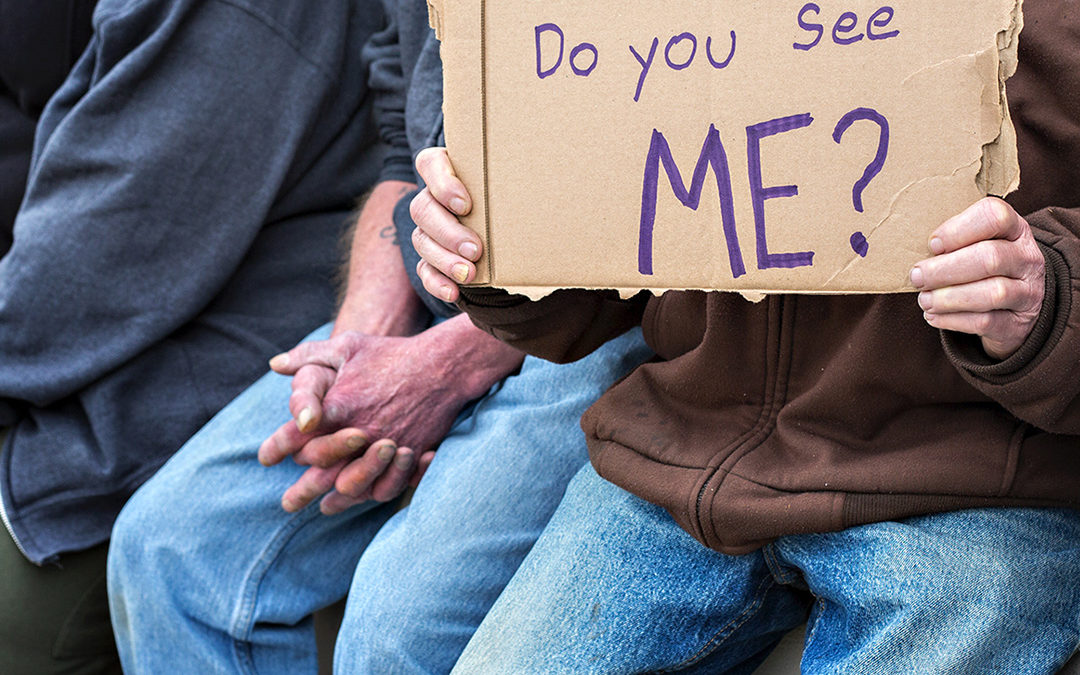
In a book called Beyond Homelessness, Theologians Brian Walsh and Stephen Bouma Prediger tell the story of two men: Kenny and Kenneth.
They are neighbors, but seemingly, they do not have a lot in common.
Kenneth is successful—he has a corporate job, travels between cities, and he owns multiple homes.
Kenny lives under a bridge and panhandles for survival.
Kenneth has power, influence, resources—but he does not know his neighbors. His life is full of movement, but empty of connection.
Kenny, for all his instability, is known. He has people, even if most of them live on the street with him. He has places where he is expected. Even if it is the outreach center where he helps prepare meals, he belongs.
The question the authors ask is: “Who is really homeless here?” And the answer is both of them, albeit in different ways.
Kenny’s homelessness is visible. Kenneth’s is hidden—social, emotional, even spiritual. But the experience of displacement is real for both.
And this is not the world God intends.
Brian Walsh puts it this way: “We live in the tension of being rooted and uprooted… homebreakers, even when we long to be homemakers.”
Scripture affirms that humanity was created for home—living in right relationship with God, one another and creation. The original “garden” home came with a purpose—caring for one another’s flourishing.
That home was fractured. But God’s intentions never changed. God goes with humanity into its homelessness—to the wilderness and into exile—drawing near through prophets, kings, and ultimately Jesus, who comes to dwell among us.
Then, in Acts 2: 42-47, we catch a glimpse of what life can look like when God comes to dwell with people once again—a community is restored, life is shared, and no one is left in need.
Today, the deepest divide between unhoused neighbors and the rest of us is not money and social problems. It is the loss of relationship—the breaking of connection that leaves people unseen, unknown and alone.
And the question that follows is this: How might we pursue them with the same goodness and mercy with which God has pursued all of us?
At the most basic level, all of us need four things: Somewhere to live, something to do, someone to love and something to hope for. Those things come more easily for some than for others.
Our unhoused neighbors are carrying more than we can see. At least 78% are living with one or more disabilities—mental health challenges, physical limitations, learning differences that have shaped their lives from a young age.
Their stories are never simple. Relationships have broken down in their lives—not only because of personal choices, but also because of family instability and systems that are often difficult to navigate. The death of parents is catastrophic for some people. Some come from families without resources to support them. Sometimes, the streets are safer than the home they left behind.
Across the country—and here in our own community—the two fastest growing groups of unhoused neighbors are between the ages of 18 and 24 and older adults over 60. If you think about the times in our lives we most need relationships, it is when we are learning to be an adult and when we get old.
Our unhoused neighbors are people whose connections have unraveled—and they need community. Not just housing. Not just services. Like all of us, they need a place to live, a reason to rise each day, relationships that are real and a reason to hope again.
Acts 2 was never meant to be a moment. It was meant to be lived out—a community shaped by God’s pursuit of us, so that we might pursue one another.
– Meghann Cotter
Executive Servant-Leader
Micah Ecumenical Ministries